

Colorlight E320 LED Receiving Card | 32 RGB Data Groups
$ 16.10
Colorlight E320 receiving card for modular LED displays, with up to 256 × 1024 pixels per card using PWM driver chips.
Loading depends on the driver IC, scan mode and frame rate. Confirm the cabinet wiring and existing configuration before ordering a replacement.
9998 in stock
Colorlight E320 LED receiving card
The Colorlight E320 is a receiving card for modular LED display systems. It receives screen data from compatible sending equipment and distributes it to LED modules. It is a cabinet-level control component, not a television or a standalone media player.
For AV integrators replacing a card or planning a cabinet, the key checks are the driver IC, scan mode, module resolution and wiring. The published maximum load depends on the driver-chip category; a single headline pixel figure does not describe every installation.
Colorlight E320 specifications and loading limits
| Normal driver chips | Up to 128 × 1024 pixels per card |
|---|---|
| PWM driver chips | Up to 256 × 1024 pixels per card |
| Shixin driver chips | Up to 162 × 1024 pixels per card |
| Scan mode | Up to 1/128 scan; confirm the actual module configuration |
| Data groups | Up to 32 groups of parallel RGB data or 32 groups of serial RGB data |
| Video and calibration | 8-bit video; pixel-level brightness and chromaticity calibration |
| Maintenance features | Cabinet highlight, OSD, rotation, cable-status monitoring and firmware readback |
| Supply / rated power | DC 3.8–5.5 V, 0.6 A / 3 W |
| Dimensions / weight | 145.2 × 91.7 × 18.4 mm / 94 g |
| Network connection | 1 Gb/s; recommended CAT5e cable up to 100 m |
Technical reference: E320 receiving card specification PDF, version V2.3.2. The document also lists 120/240 Hz operation and explicitly notes an effect on loading capacity. Confirm the supported load at your required frame rate before ordering.
Match the card to the cabinet
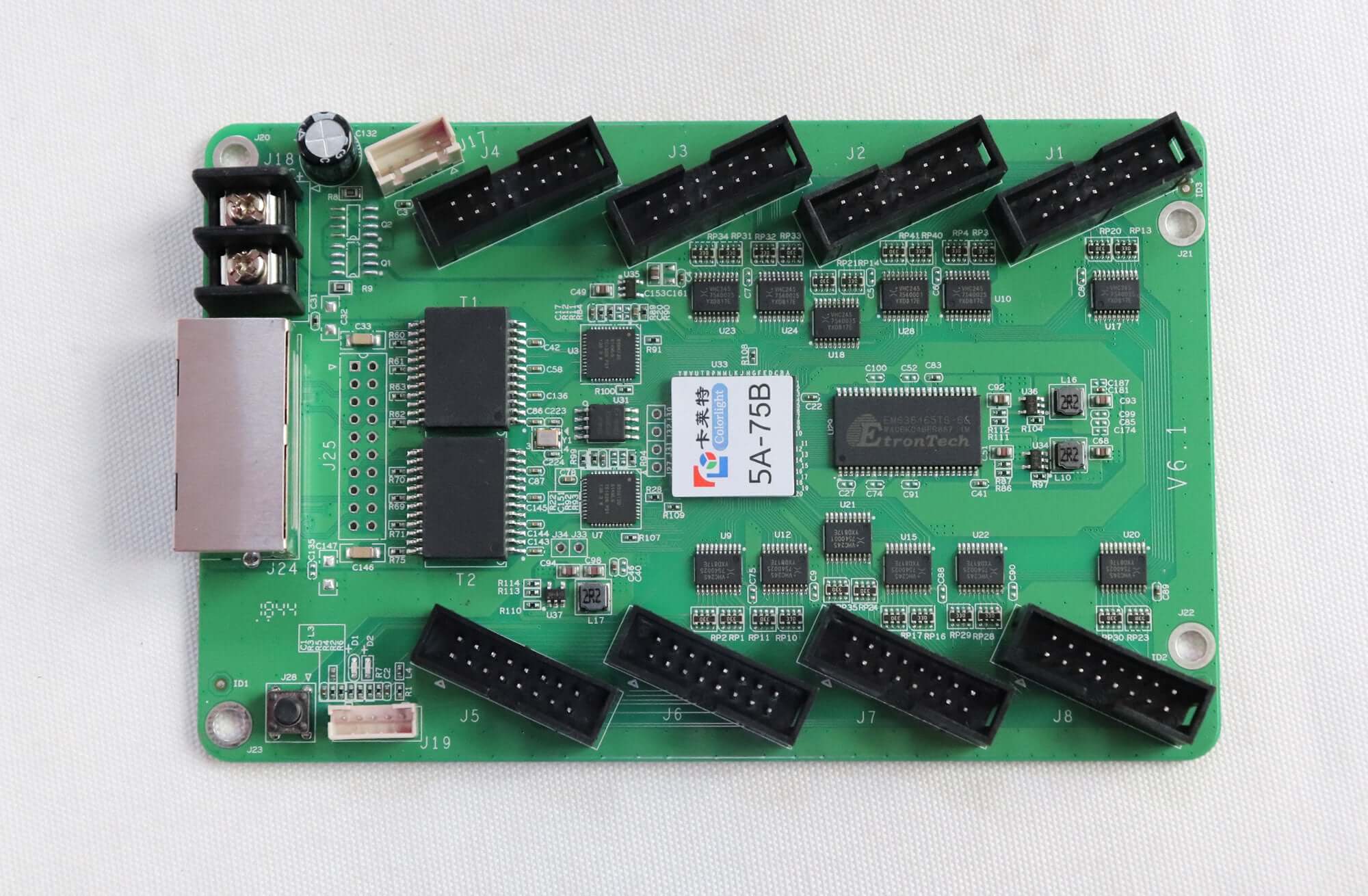
Use the product image to identify the card layout, then compare it with the existing board. Record the module model, driver IC, scan ratio, connector pinout and cable direction. A matching connector shape alone does not establish electrical or configuration compatibility.
For example, a 256 × 512 cabinet contains 131,072 pixels. That arithmetic is useful for planning, but it does not prove that a particular card orientation, scan setting or driver IC will support the layout. Have the complete cabinet configuration checked instead of selecting solely by total pixel count.
When reviewing the complete system, you can browse our LED receiving cards and LED sending cards. Keep the sender, receiver and module configuration in the same project record.
Frequently asked questions
What power and dimensions does the E320 require?
V2.3.2 specifies DC 3.8–5.5 V, 0.6 A and 3 W rated power. Dimensions are 145.2 × 91.7 × 18.4 mm, with a weight of 94 g. Use only one of the two power inputs as instructed in the document.
Does 240 Hz mean the maximum load always applies?
No. The referenced specification states that high-frame-rate operation affects the load. Frame rate and the LED module’s refresh behavior are different parameters. Send both requirements, together with the driver IC and scan mode, for a configuration review.
Can an E320 play a video file by itself?
No. The receiving card is part of the LED control chain. Plan compatible sending equipment and a content source; do not treat the board as a complete playback system. For stored-content projects, review our LED media players with the proposed screen setup.
What should be saved before replacing a receiving card?
Save the working screen configuration and calibration data where available. Photograph the wiring, label the cables and record the current hardware and firmware versions. Have the replacement and configuration file checked before installing it across the screen.
Does loop redundancy remove the need for a wiring plan?
No. The specification includes loop redundancy, but a redundant path must be designed and configured with the sending equipment. Ask for the connection plan and a commissioning test; do not assume that simply adding a second cable establishes a working backup.
Request an E320 compatibility check
Ask EagerLED to check your Colorlight E320 configuration. Provide clear photos of the existing card and connectors, cabinet pixel dimensions, module and driver IC details, scan ratio, sender model, firmware version, required frame rate and quantity.
Include the delivery destination and ask sales to confirm the supplied hardware revision, accessories, availability, freight and delivery estimate for your order. For repairs, keep the original configuration until the replacement has been tested on the actual cabinet.
| Weight | 0.35 kg |
|---|
Be the first to review “Colorlight E320 LED Receiving Card | 32 RGB Data Groups”
You must be logged in to post a review.
Will I be charged with customs and taxes?
The prices displayed on our site are tax-free (in US Dollars), which means you may be required to pay import duties and taxes once you receive your order. Import taxes, duties, and related customs fees will be determined by your local customs office when your order arrives at its final destination.
Please note that these additional charges and taxes are your responsibility, and we do not take any responsibility for them. We are not liable for paying or reimbursing any customs duties, taxes, or related fees. For more details on these charges, please contact your local customs office.
Shipping
We can ship to virtually any address in the world. Note that there are restrictions on some products, and some products cannot be shipped to international destinations..
When you place an order, we will estimate shipping and delivery dates for you based on the availability of your items and the shipping options you choose. Depending on the shipping provider you choose, shipping date estimates may appear on the shipping quotes page.
Please also note that the shipping rates for many items we sell are weight-based. The weight of any such item can be found on its detail page. To reflect the policies of the shipping companies we use, all weights will be rounded up to the next full pound..
Returns Policy
You may return most new, unopened items within 30 days of delivery for a full refund. We'll also pay the return shipping costs if the return is a result of our error (you received an incorrect or defective item, etc.)..
You should expect to receive your refund within four weeks of giving your package to the return shipper, however, in many cases you will receive a refund more quickly. This time period includes the transit time for us to receive your return from the shipper (5 to 10 business days), the time it takes us to process your return once we receive it (3 to 5 business days), and the time it takes your bank to process our refund request (5 to 10 business days).
If you need to return an item, simply login to your account, view the order using the "Complete Orders" link under the My Account menu and click the Return Item(s) button. We'll notify you via e-mail of your refund once we've received and processed the returned item..
Related products




Reviews
There are no reviews yet.