NovaStar AD20 LED Multimedia Player with HDMI Input and Loop
$ 142.00
NovaStar AD20 multimedia player combines playback and transmission for LED advertising screens with up to 1.3 million pixels.
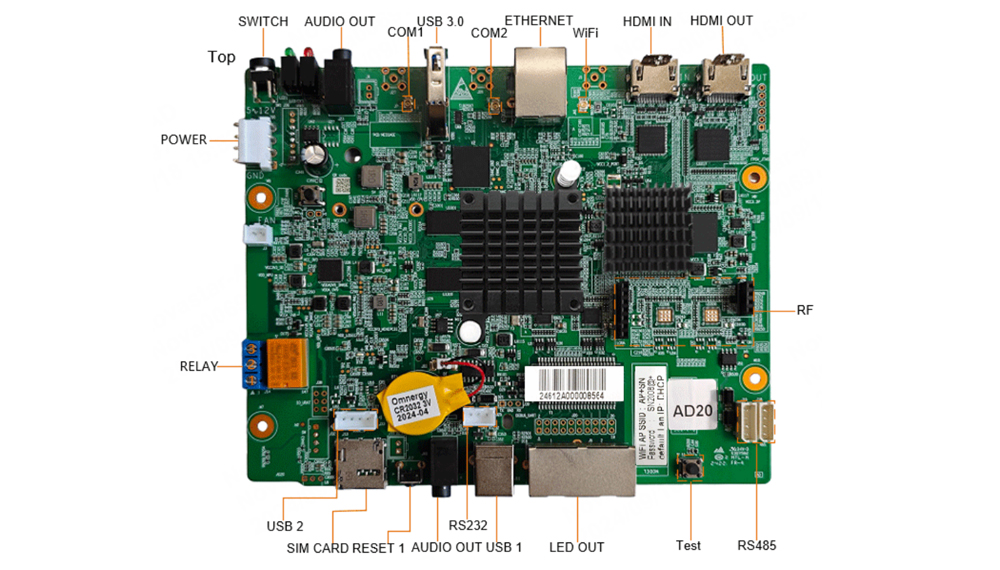
- 2 Gigabit LED outputs with configurable primary/backup topology
- HDMI input for synchronous mode; internal-source asynchronous playback
- HDMI Loop output up to 1080p at 60 Hz
- 1 GB RAM, 32 GB storage and USB playback
- Optional 4G; specified modules required for GPS/RF synchronization
10000 in stock
NovaStar AD20 multimedia player for LED advertising displays
The NovaStar AD20 combines media playback and LED transmission on one control board for advertising screens and multi-screen signage. It supports up to 1.3 million LED pixels, with asynchronous playback from its internal media source or synchronous playback from an HDMI input. Network publishing and monitoring support managing displays across locations through the appropriate software and network setup.
The board uses a quad-core ARM Cortex-A55 processor at 1.8 GHz, with 1 GB RAM and 32 GB internal storage. Select it by the screen’s physical pixel matrix, receiving-card configuration and required playback mode.
AD20 loading capacity and video connections
| Item | Specification and conditions |
|---|---|
| LED capacity | Up to 1,300,000 pixels total; maximum width 4096 pixels or maximum height 4096 pixels within that total |
| LED outputs | 2 Gigabit LED output ports; default two primary ports, configurable as one primary and one backup |
| HDMI input | 1 HDMI 1.4 input for synchronous playback; full-screen scaling supports source widths from 64 to 2048 pixels and downscaling only |
| HDMI output | 1 HDMI 1.4 output, up to 1080p at 60 Hz; HDMI Loop supported for cascading |
| Management Ethernet | A separate Gigabit network port for content publishing and display control |
| Sensors / audio | 2 sensor interfaces for compatible brightness or temperature/humidity sensors; stereo audio output, with 48 kHz internal-source sampling |
The maximum width and height are separate shape limits. A 4096 × 4096 screen exceeds the 1.3-million-pixel budget. Configuring an output as backup changes the active output topology; confirm the required loading and redundancy arrangement before deployment.
Synchronous, asynchronous and multi-screen playback
In asynchronous mode, AD20 plays its internal media source. In synchronous mode, it uses the HDMI input. The documented full-screen scaling function can reduce a suitable input image to fit the display; it does not upscale a smaller source. Multi-screen splicing uses HDMI input/output cascading and requires a matching screen layout and configuration.
4K media decoding does not mean 4K HDMI output or a 4K LED canvas. The V1.0.1 decoding table lists H.265/HEVC up to 4096 × 2304 at 60 fps, while H.264 at that resolution is limited to 30 fps. HDMI output remains limited to 1080p at 60 Hz, and LED loading remains limited to 1.3 million pixels. Test the actual codec, frame rate and layout used in the project.
NTP time synchronization is supported. GPS synchronization requires a specified 4G module, while RF synchronization requires a specified RF module. A 4G module is not included by default. Wi-Fi supports switching between AP and STA modes; network priority is wired Ethernet, then Wi-Fi, then optional 4G.
USB playback and installation requirements
The USB 3.0 Type A port supports flash-drive program playback and firmware upgrades. Use FAT32 or NTFS media, with a documented drive capacity of 2–128 GB and individual files greater than 0 KB but smaller than 4 GB. USB Type B provides direct computer publishing and screen control. The additional connector marked USB 2 is reserved.
| Power input / maximum consumption | DC 5–12 V / 18 W |
|---|---|
| Dimensions / net weight | 165.0 × 139.8 × 20.3 mm / 183.8 g |
| Operating environment | −20°C to +60°C; 0–80% RH, non-condensing |
| Software | Android 11 system software; installation of third-party applications is not supported |

NovaStar AD20 questions
Can AD20 drive a 1920 × 1080 LED screen?
That matrix contains 2,073,600 pixels, exceeding AD20’s 1.3-million-pixel capacity. The 1080p HDMI output specification does not change the LED loading limit.
Does full-screen adaptive playback enlarge the source?
No. The documented synchronous-mode scaling supports downscaling, not upscaling, with a source width between 64 and 2048 pixels.
Are 4G and GPS included?
4G is optional. GPS synchronization needs the specified 4G module, and RF synchronization needs its specified RF module. Confirm the required accessories and regional network compatibility.
What information is needed for a replacement check?
Send the screen pixel dimensions, receiving-card model, existing controller and software versions, supply voltage, HDMI source timing, and required sensors or synchronization modules.
AD20 specification and configuration enquiry
Reference: NovaStar AD20 specification (Chinese), V1.0.1, released August 29, 2025. Browse NovaStar control products or contact EagerLED for a configuration check and quotation.
| Weight | 13 kg |
|---|
Be the first to review “NovaStar AD20 LED Multimedia Player with HDMI Input and Loop”
You must be logged in to post a review.
Will I be charged with customs and taxes?
The prices displayed on our site are tax-free (in US Dollars), which means you may be required to pay import duties and taxes once you receive your order. Import taxes, duties, and related customs fees will be determined by your local customs office when your order arrives at its final destination.
Please note that these additional charges and taxes are your responsibility, and we do not take any responsibility for them. We are not liable for paying or reimbursing any customs duties, taxes, or related fees. For more details on these charges, please contact your local customs office.
Shipping
We can ship to virtually any address in the world. Note that there are restrictions on some products, and some products cannot be shipped to international destinations..
When you place an order, we will estimate shipping and delivery dates for you based on the availability of your items and the shipping options you choose. Depending on the shipping provider you choose, shipping date estimates may appear on the shipping quotes page.
Please also note that the shipping rates for many items we sell are weight-based. The weight of any such item can be found on its detail page. To reflect the policies of the shipping companies we use, all weights will be rounded up to the next full pound..
Returns Policy
You may return most new, unopened items within 30 days of delivery for a full refund. We'll also pay the return shipping costs if the return is a result of our error (you received an incorrect or defective item, etc.)..
You should expect to receive your refund within four weeks of giving your package to the return shipper, however, in many cases you will receive a refund more quickly. This time period includes the transit time for us to receive your return from the shipper (5 to 10 business days), the time it takes us to process your return once we receive it (3 to 5 business days), and the time it takes your bank to process our refund request (5 to 10 business days).
If you need to return an item, simply login to your account, view the order using the "Complete Orders" link under the My Account menu and click the Return Item(s) button. We'll notify you via e-mail of your refund once we've received and processed the returned item..
Related products
Reviews
There are no reviews yet.