


NovaStar TCC160 Asynchronous LED Display Control Card
$ 79.00
NovaStar TCC160 integrates asynchronous media playback, sending and receiving. Compare PWM and general-driver loading limits, cascaded configurations, USB control and Wi-Fi AP/STA. A 4G module is optional; GPS availability and the documented loading discrepancy require configuration checks.
9982 in stock
NovaStar TCC160 asynchronous LED display control card
The NovaStar TCC160 integrates media playback, sending and receiving for asynchronous full-color LED displays. Publish content and control screens from a computer, phone or tablet, with cloud-based publishing and monitoring available for connected installations.
Selection depends on the driver IC, local module load and cascaded configuration. The specifications below distinguish LED loading from video decoding and preserve the limits in the original V1.0.1 reference.
TCC160 loading and hardware specifications
| Local load with PWM driver ICs | 512 × 512 at 60 Hz |
|---|---|
| Local load with general driver ICs | 512 × 384 at 60 Hz |
| Local dimension statement | Maximum width/height 2048 pixels; document states capacity not exceeding 260,000 pixels |
| Multiple TCC160 units cascaded | Up to 650,000 pixels; maximum width/height 2048 pixels within that total |
| Ultra-long screen | Maximum width 8192 pixels; maximum height 2560 pixels; maximum capacity per Ethernet port 650,000 pixels |
| Data groups | Up to 32 parallel RGB groups or 64 serial groups, expandable to 128 serial groups |
| Processor and storage | Quad-core 1.4 GHz; 2 GB RAM; 32 GB internal storage |
| USB | 1 USB 2.0 Type-A for playback, upgrades, storage expansion and logs; 1 USB Type-B for computer publishing and control |
| Audio / sensors | 1 stereo audio output; 2 RS485 connectors for compatible sensors or modules |
| Relay | Maximum DC 30 V, 3 A |
Loading clarification: 512 × 512 equals 262,144 pixels, while the same specification states a 260,000-pixel cap in its local dimension note. Both original statements are retained here. Confirm the applicable limit for the driver IC and layout before ordering. Maximum width and height are independent limits, not a supported full-size rectangle.
Media playback and screen synchronization
The original playback options are one 4K, three 1080p, eight 720p, ten 480p or sixteen 360p videos. These are alternative decoding workloads. Enabling synchronized playback across screens halves the decoding capability. A 4K media decoder does not establish a native 4K LED canvas.
NTP and GPS time synchronization appear in the feature list. However, V1.0.1 describes the UART connection for a third-party GPS module as a function for future updates. Confirm the installed firmware and module support before relying on GPS positioning or timing.
Network connections and receiving-card functions
Wi-Fi AP and Wi-Fi STA can operate together, providing local hotspot access and a connection to an existing network. The factory AP name uses “AP” plus the last eight serial-number digits; its password is printed on the product’s SSID label. A 4G module is optional and must be purchased separately.
Receiving-card functions include color management with Rec.709, DCI-P3, Rec.2020 and custom gamuts; 18bit+ processing; individual RGB Gamma adjustment with compatible NovaLCT/controller support; and rotation in 90° increments. Low latency is disabled by default and requires driver ICs with built-in RAM to achieve the stated one-frame receiving-end latency.
Temperature and voltage monitoring, Ethernet bit-error detection, firmware and configuration readback, and dual program backup support maintenance. Mapping 1.1 is available for cascaded receiving cards. The listed three-color, 16-pixel serial-input feature applies to PWM chips.
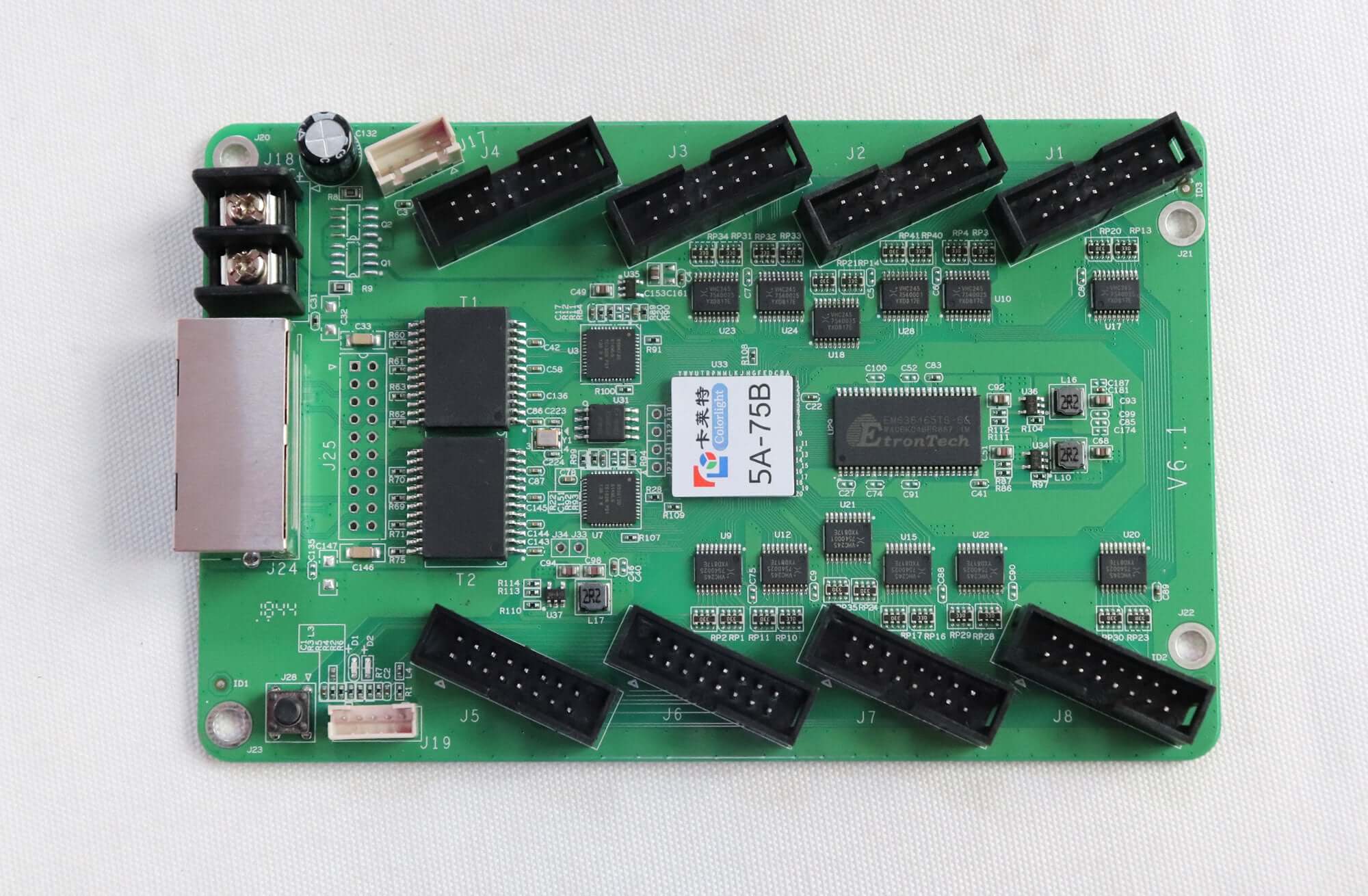
Product views

TCC160 frequently asked questions
Is a 4G module supplied with the TCC160?
No. The original specification says the board ships without a 4G module. Confirm the module, regional network bands and accessories separately when requesting a mobile-network configuration.
Do PWM and general driver ICs have the same loading limit?
No. The local load is specified as 512 × 512 at 60 Hz for PWM driver ICs and 512 × 384 at 60 Hz for general driver ICs. The document’s separate 260,000-pixel statement also needs checking for the actual layout.
Are the two USB connections interchangeable?
No. Type-A supports USB playback and maintenance functions. Type-B connects to the control computer for publishing and screen control. Choose the port according to the intended task.
Can synchronized playback use the full normal decoding workload?
No. The original specification states that synchronization halves decoding capability. Test the intended media workload with synchronization enabled.
What information is needed for a TCC160 system check?
Provide the module driver IC and scan ratio, screen resolution, local and cascaded loads, cabinet wiring and required media streams. Include synchronization, 4G, GPS and sensor requirements so their hardware and firmware conditions can be verified.
Original specification and configuration help
Download the NovaStar TCC160 specification. The linked document is V1.0.1, dated September 4, 2024.
Send EagerLED your TCC160 screen configuration for compatibility and quotation assistance.
| Weight | 1 kg |
|---|
Be the first to review “NovaStar TCC160 Asynchronous LED Display Control Card”
You must be logged in to post a review.
Will I be charged with customs and taxes?
The prices displayed on our site are tax-free (in US Dollars), which means you may be required to pay import duties and taxes once you receive your order. Import taxes, duties, and related customs fees will be determined by your local customs office when your order arrives at its final destination.
Please note that these additional charges and taxes are your responsibility, and we do not take any responsibility for them. We are not liable for paying or reimbursing any customs duties, taxes, or related fees. For more details on these charges, please contact your local customs office.
Shipping
We can ship to virtually any address in the world. Note that there are restrictions on some products, and some products cannot be shipped to international destinations..
When you place an order, we will estimate shipping and delivery dates for you based on the availability of your items and the shipping options you choose. Depending on the shipping provider you choose, shipping date estimates may appear on the shipping quotes page.
Please also note that the shipping rates for many items we sell are weight-based. The weight of any such item can be found on its detail page. To reflect the policies of the shipping companies we use, all weights will be rounded up to the next full pound..
Returns Policy
You may return most new, unopened items within 30 days of delivery for a full refund. We'll also pay the return shipping costs if the return is a result of our error (you received an incorrect or defective item, etc.)..
You should expect to receive your refund within four weeks of giving your package to the return shipper, however, in many cases you will receive a refund more quickly. This time period includes the transit time for us to receive your return from the shipper (5 to 10 business days), the time it takes us to process your return once we receive it (3 to 5 business days), and the time it takes your bank to process our refund request (5 to 10 business days).
If you need to return an item, simply login to your account, view the order using the "Complete Orders" link under the My Account menu and click the Return Item(s) button. We'll notify you via e-mail of your refund once we've received and processed the returned item..
Related products



Reviews
There are no reviews yet.