
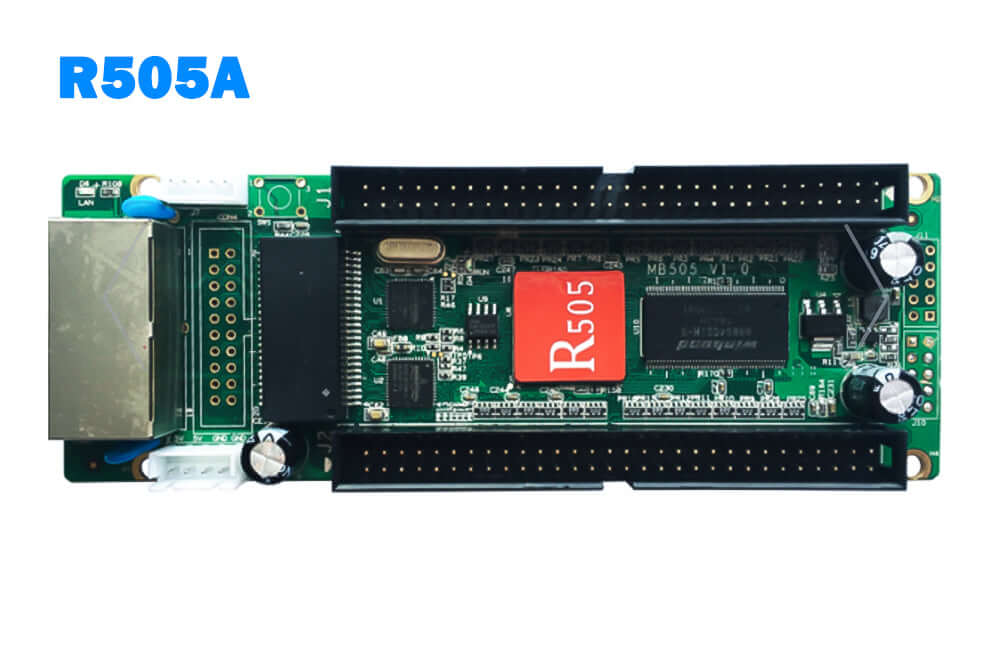
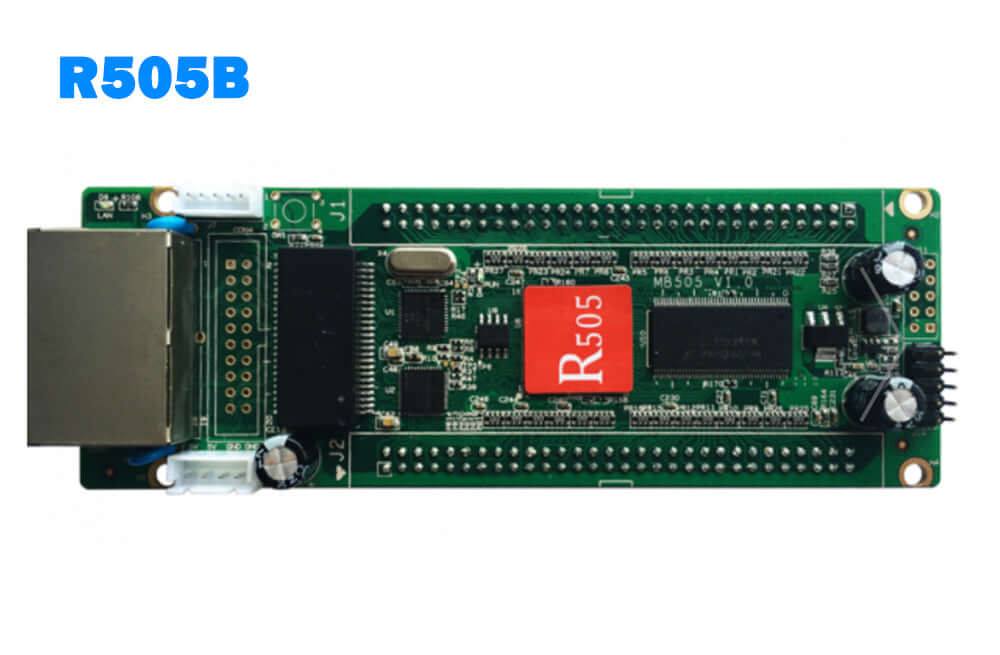
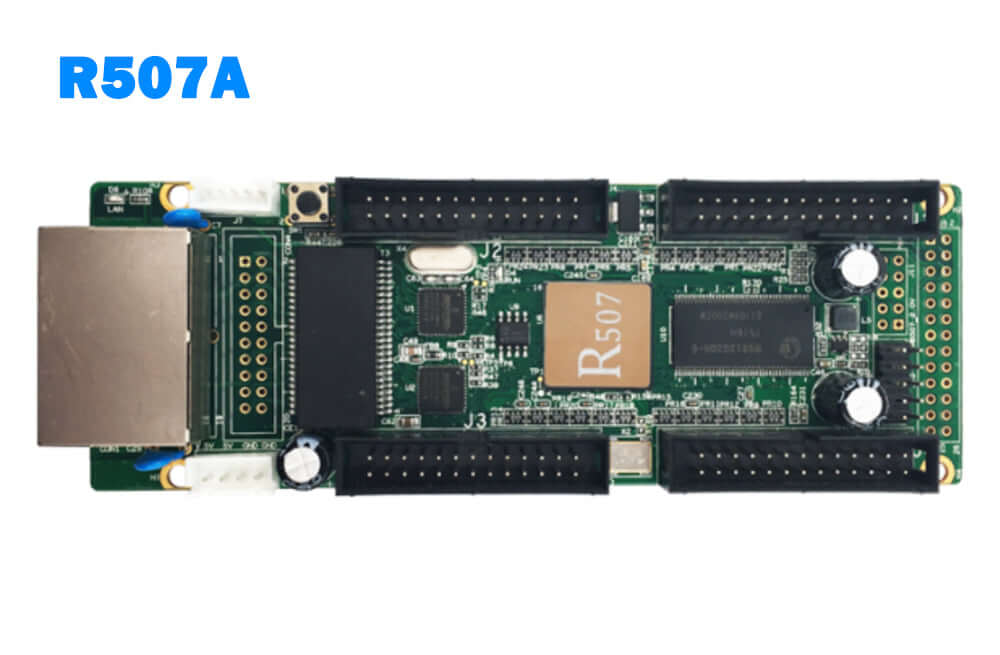
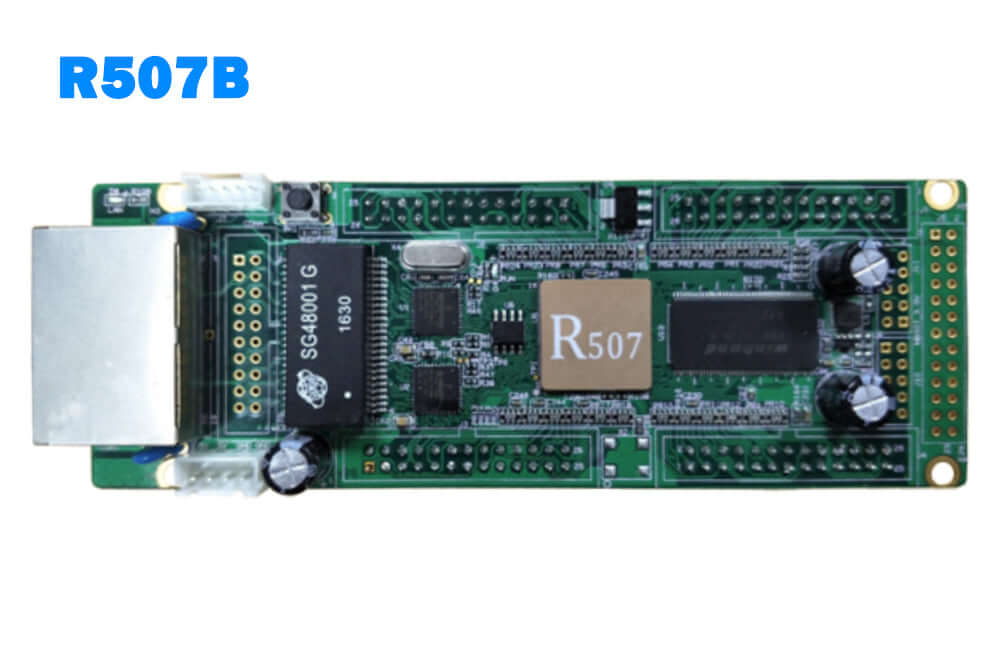
Huidu R505 / R507 LED Receiving Cards for Asynchronous Systems
Price range: $ 16.00 through $ 18.00
Huidu R505 and R507 receiving cards for compatible A60X, A30/A30+, C30 and C10 sending systems. Compare the model-specific connectors and recommended 256 × 192-pixel loading. Review the document discrepancies before selecting a replacement.
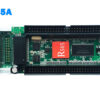
Huidu R505 and R507 LED receiving cards
The Huidu R505 and R507 are receiving cards for compatible asynchronous LED control systems. They work downstream of a sending card and connect to the LED cabinet through the appropriate adapter interface. Their connectors differ, so select the exact model to match the existing cabinet hardware.
Model comparison and specifications
| Parameter | R505 | R507 |
|---|---|---|
| Source document | R505 V3.0 | R507(A) V4.0 |
| Output interface | 2 × 60-pin universal interfaces | Appearance section: 4 × 26-pin outputs; port table differs—see note below |
| Recommended loading | 256 × 192 pixels | 256 × 192 pixels |
| Scan modes | Static through 1/32 scan | Static through 1/32 scan |
| Ethernet | 2 Gigabit ports | 2 Gigabit ports |
| Listed sending cards | A60X, A30, A30+, C30, C10 | A60X, A30, A30+, C30, C10 |
| Grayscale | 0–65,536 | 0–65,536 |
| Recommended supply | Standard 5 V | Standard 5 V |
Check the board revision before replacement
The PDFs describe HDPlayer smart settings, configurable receiving-card order and onboard test patterns. They list support for conventional and specified PWM driver ICs, including MBI5041/5042, MBI5050, MY9221 and MY9268. Match the module driver, scan mode and adapter wiring before applying settings.
Source discrepancies: Both PDFs list maximum loading as “190,000 points, 1024 × 192”; these figures differ mathematically. Both give 4–6 V in one section and 4.2–5.5 V in the technical table, and temperature upper limits of 85°C and 80°C in different sections. The R507 port table lists eight HUB75E ports, while its appearance section describes four 26-pin outputs. Confirm these details against the supplied hardware rather than treating the conflicting entries as interchangeable specifications.
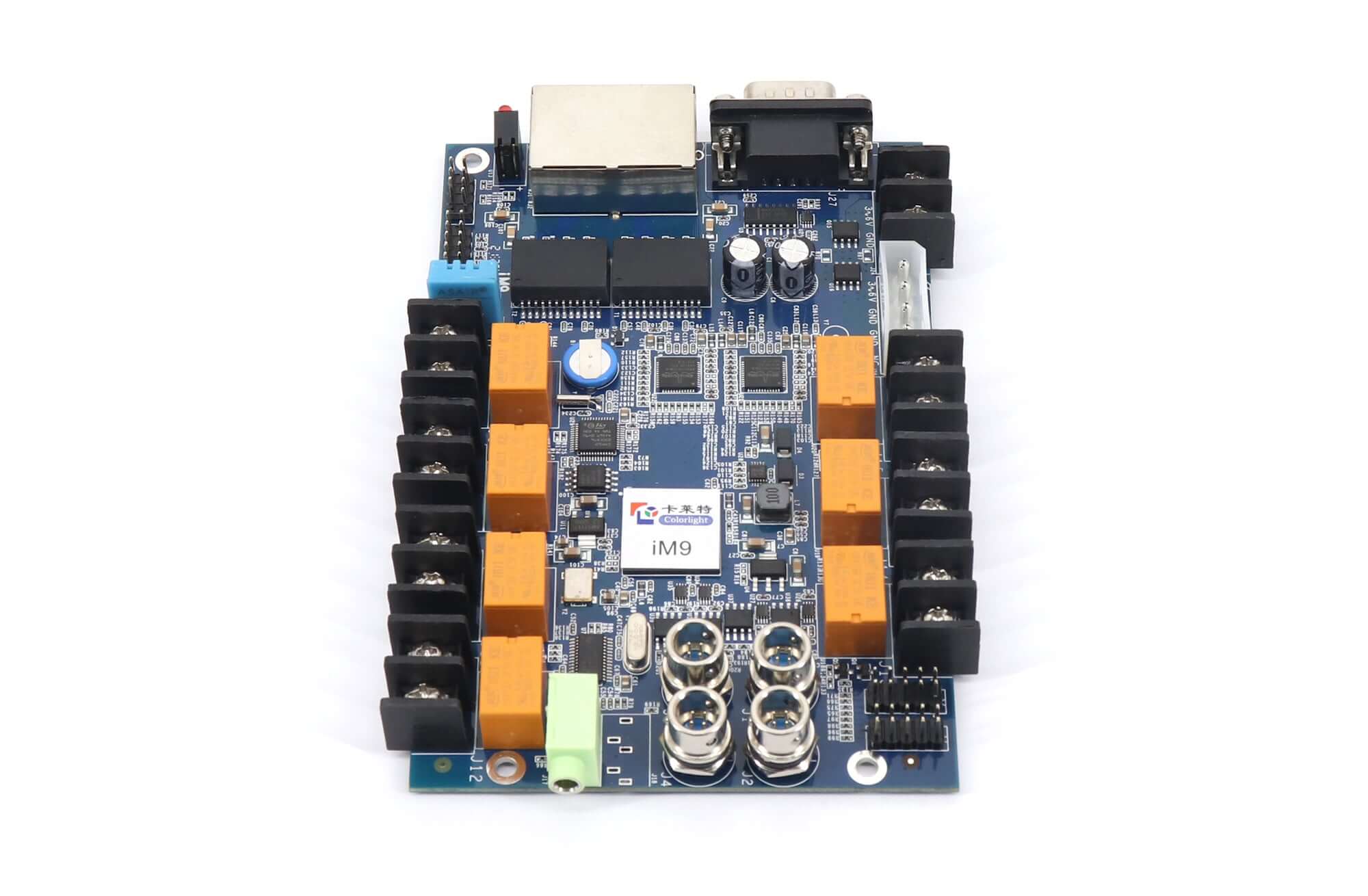
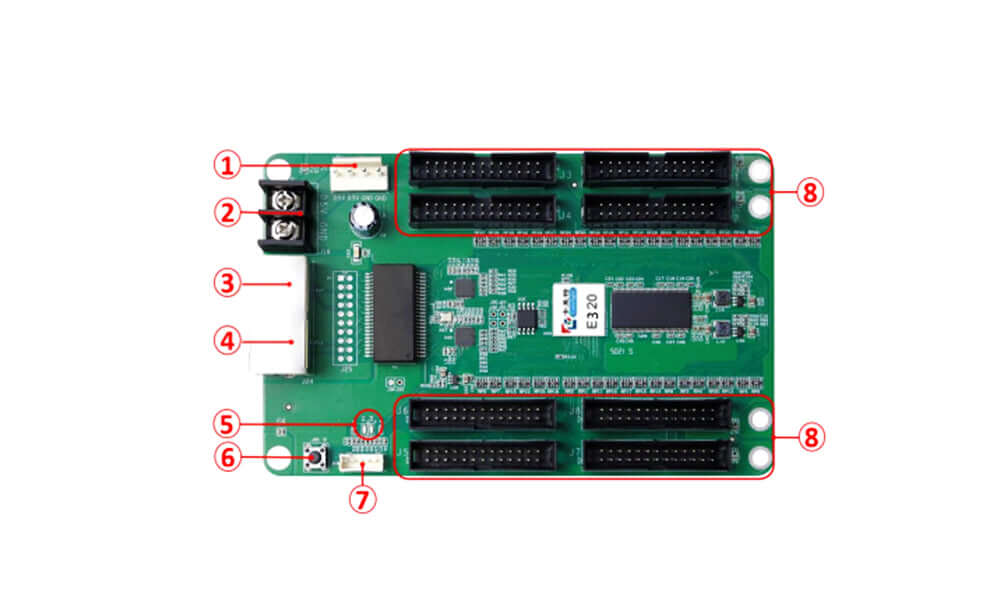
Original product images
Frequently asked questions
What is the difference between the R505 and R507 connectors?
The R505 document describes two 60-pin outputs. The R507 appearance section describes four 26-pin outputs, but its port table says eight HUB75E ports. Check the actual R507 board and adapter pinout before purchase; do not treat the two models as plug-in equivalents.
What loading range should I use?
Both linked PDFs recommend 256 × 192 pixels. They also list “190,000 points” and “1024 × 192” together as maximum figures, which are not numerically identical. Confirm the intended module and scan configuration instead of relying on an assumed maximum.
Which sending cards are listed as compatible?
Both documents name Huidu A60X, A30, A30+, C30 and C10 asynchronous sending cards. Confirm hardware and firmware compatibility for the complete system before replacing a receiving card.
What voltage do these receiving cards require?
Both documents recommend a standard 5 V supply. Their technical tables list 4.2–5.5 V, while an earlier parameter section gives 4–6 V. Use the marked rating for the supplied board and confirm the power connection through the terminal or adapter board.
Specification downloads
| Weight | N/A |
|---|
Be the first to review “Huidu R505 / R507 LED Receiving Cards for Asynchronous Systems”
You must be logged in to post a review.
Will I be charged with customs and taxes?
The prices displayed on our site are tax-free (in US Dollars), which means you may be required to pay import duties and taxes once you receive your order. Import taxes, duties, and related customs fees will be determined by your local customs office when your order arrives at its final destination.
Please note that these additional charges and taxes are your responsibility, and we do not take any responsibility for them. We are not liable for paying or reimbursing any customs duties, taxes, or related fees. For more details on these charges, please contact your local customs office.
Shipping
We can ship to virtually any address in the world. Note that there are restrictions on some products, and some products cannot be shipped to international destinations..
When you place an order, we will estimate shipping and delivery dates for you based on the availability of your items and the shipping options you choose. Depending on the shipping provider you choose, shipping date estimates may appear on the shipping quotes page.
Please also note that the shipping rates for many items we sell are weight-based. The weight of any such item can be found on its detail page. To reflect the policies of the shipping companies we use, all weights will be rounded up to the next full pound..
Returns Policy
You may return most new, unopened items within 30 days of delivery for a full refund. We'll also pay the return shipping costs if the return is a result of our error (you received an incorrect or defective item, etc.)..
You should expect to receive your refund within four weeks of giving your package to the return shipper, however, in many cases you will receive a refund more quickly. This time period includes the transit time for us to receive your return from the shipper (5 to 10 business days), the time it takes us to process your return once we receive it (3 to 5 business days), and the time it takes your bank to process our refund request (5 to 10 business days).
If you need to return an item, simply login to your account, view the order using the "Complete Orders" link under the My Account menu and click the Return Item(s) button. We'll notify you via e-mail of your refund once we've received and processed the returned item..
Related products
Reviews
There are no reviews yet.